

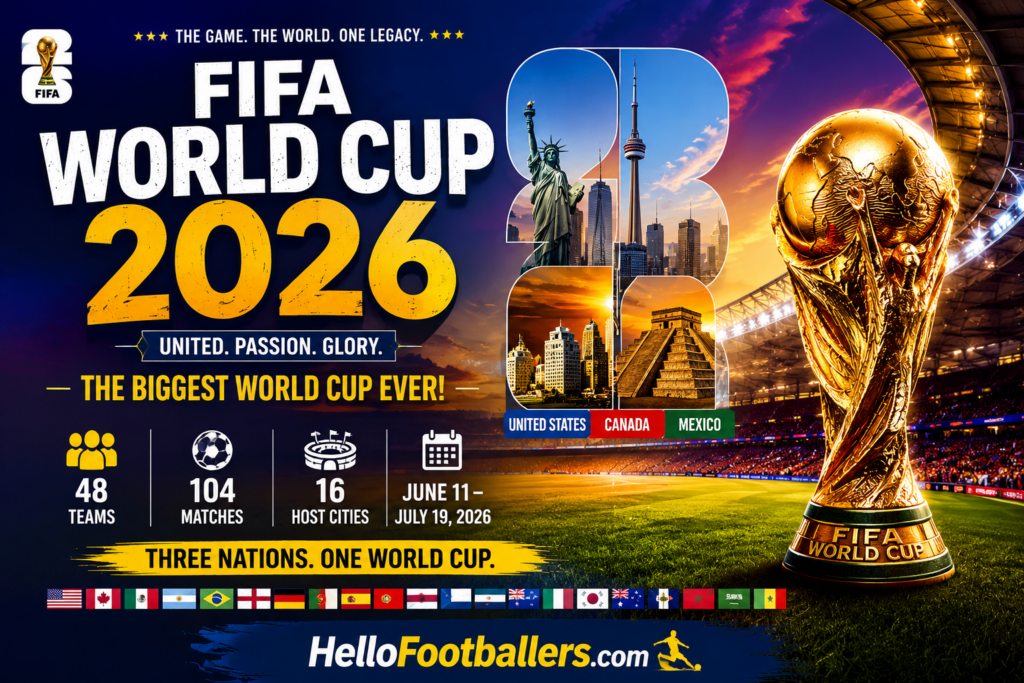
The FIFA World Cup 2026 is set to become the biggest and most ambitious football tournament ever organized. For the first time in history, the competition will feature 48 national teams instead of 32 and will be jointly hosted by three countries: the United States, Canada, and Mexico. The tournament is expected to attract millions of fans from around the world and generate record-breaking television audiences.
Football supporters across the United States, India, Europe, South America, Africa, and Asia are eagerly awaiting the competition, which promises more matches, more drama, and more opportunities for nations to compete on the biggest stage in world football.
The FIFA World Cup is not just a sporting event; it is a global celebration that brings together different cultures, nations, and communities through the shared passion for football. With expanded participation and world-class venues, the 2026 edition is expected to be one of the most memorable tournaments in football history.
Quick Facts About FIFA World Cup 2026
| Category | Details |
|---|---|
| Tournament | FIFA World Cup 2026 |
| Edition | 23rd FIFA World Cup |
| Host Countries | United States, Canada, Mexico |
| Number of Teams | 48 |
| Number of Matches | 104 |
| Tournament Dates | June 11, 2026 – July 19, 2026 |
| Defending Champions | Argentina |
| Final Venue | MetLife Stadium, New Jersey |
| First Expanded World Cup | Yes |
| First Three-Nation Host | Yes |
| Official website | Click Here |
History of the FIFA World Cup
The FIFA World Cup is the most prestigious international football competition in the world. Organized by FIFA, the tournament takes place every four years and features the best national teams from across the globe.
The inaugural FIFA World Cup was held in Uruguay in 1930 and featured only 13 teams. Since then, the competition has grown into the world’s largest sporting event.
Some of the most successful nations in World Cup history include:
Brazil
- World Cup Titles: 5
- Years Won: 1958, 1962, 1970, 1994, 2002
Brazil remains the most successful nation in FIFA World Cup history and has participated in every edition of the tournament.
Germany
- World Cup Titles: 4
Germany has consistently been one of the strongest football nations and has appeared in numerous finals.
Italy
- World Cup Titles: 4
Italy is known for its tactical excellence and rich football tradition.
Argentina
- World Cup Titles: 3
Argentina entered the 2026 World Cup as the defending champion after lifting the trophy in Qatar in 2022.
France
- World Cup Titles: 2
France has become one of the dominant forces in modern international football.
Over the decades, the FIFA World Cup has produced legendary players, unforgettable matches, and iconic moments that continue to inspire football fans worldwide.
Why FIFA World Cup 2026 Is Historic
The 2026 edition is unlike any previous FIFA World Cup.
Several historic milestones make this tournament unique:
First 48-Team World Cup
Previous tournaments featured 32 teams. The 2026 edition expands participation to 48 nations, giving more countries the opportunity to compete on football’s biggest stage.
First World Cup Hosted by Three Nations
For the first time in FIFA history, three countries will jointly host the tournament:
- United States
- Canada
- Mexico
Record Number of Matches
The tournament will feature 104 matches, making it the largest World Cup ever held.
More Opportunities for Emerging Nations
The expansion allows more teams from Africa, Asia, North America, and Oceania to qualify.
Greater Global Reach
The tournament is expected to attract billions of viewers and become one of the most watched sporting events in history.
FIFA World Cup 2026 Format Explained
One of the biggest changes introduced for 2026 is the new competition format.
Previous World Cup Format
Before 2026:
- 32 teams
- 8 groups
- 4 teams per group
- Top 2 teams advanced
- 64 total matches
New 2026 Format
For FIFA World Cup 2026:
- 48 teams
- 12 groups
- 4 teams in each group
- Top 2 teams from each group qualify
- Best 8 third-placed teams also qualify
- Round of 32 introduced
- 104 matches overall
This structure creates a longer and more competitive tournament while ensuring that more nations remain involved throughout the group stage.
FIFA World Cup 2026 Qualification Process
The qualification process involves all six FIFA confederations.
AFC (Asia)
Asian nations compete through AFC qualification tournaments.
Potential qualifiers include:
- Japan
- South Korea
- Iran
- Saudi Arabia
- Australia
- Uzbekistan
- Iraq
- Qatar
CAF (Africa)
Africa receives a significant increase in qualification spots.
Strong contenders include:
- Morocco
- Senegal
- Egypt
- Nigeria
- Algeria
- Tunisia
- Cameroon
- Ghana
UEFA (Europe)
Europe receives the highest number of qualification places.
Expected contenders include:
- England
- France
- Spain
- Germany
- Portugal
- Italy
- Netherlands
- Belgium
CONMEBOL (South America)
South American qualification remains one of the toughest in world football.
Top contenders include:
- Argentina
- Brazil
- Uruguay
- Colombia
- Ecuador
CONCACAF (North America)
The United States, Canada, and Mexico automatically qualify as hosts.
Other nations will compete for remaining places.
OFC (Oceania)
For the first time, Oceania receives a guaranteed qualification slot.
New Zealand is widely considered the favorite.
FIFA World Cup 2026 Schedule
The tournament will begin on June 11, 2026 and conclude on July 19, 2026.
Group Stage
June 11 – June 27, 2026
The group stage will feature all 48 teams competing across 12 groups.
Round of 32
Late June and Early July
This new knockout stage is being introduced due to the expansion.
Round of 16
Early July
The remaining teams battle for quarter-final positions.
Quarter-Finals
Mid July
Eight teams compete for a place in the semi-finals.
Semi-Finals
Mid July
The final four nations battle for a place in the World Cup Final.
Third-Place Playoff
July 18, 2026
The two losing semi-finalists compete for third place.
FIFA World Cup Final
July 19, 2026
The final will determine the world champion.
Host Countries of FIFA World Cup 2026
United States
The United States will host the majority of World Cup matches and play a central role in the tournament.
Football has experienced remarkable growth in America over the past decade, driven by:
- Major League Soccer (MLS)
- Youth development programs
- International stars joining American clubs
- Growing fan support
The USA is expected to host over 75 matches during the tournament.
Canada
Canada continues to establish itself as a rising football nation.
The country’s successful qualification campaigns and increasing investment in football infrastructure have strengthened its international reputation.
Canada will host matches in Toronto and Vancouver.
Mexico
Mexico becomes the first nation in football history to host World Cup matches in three different editions.
Previous tournaments hosted by Mexico:
- 1970
- 1986
- 2026
Mexico’s football culture, passionate supporters, and historic stadiums make it one of the most exciting host nations.
FIFA World Cup 2026 Host Cities
A total of 16 cities will host matches across North America.
United States Host Cities
New York / New Jersey
This region will host the FIFA World Cup 2026 Final.
MetLife Stadium is one of the largest sporting venues in North America and will become the center of world football on July 19, 2026.
Los Angeles, California
Los Angeles is one of the world’s most famous cities and a major sports destination.
The city offers world-class infrastructure, entertainment, and international appeal.
Dallas, Texas
Dallas will host several major matches and is home to one of the largest stadiums in the tournament.
Houston, Texas
Houston’s diverse population and passionate football community make it an ideal World Cup host city.
Miami, Florida
Miami is considered one of the football capitals of North America and serves as a gateway between North and South America.
Atlanta, Georgia
Atlanta has become one of the fastest-growing sports cities in the United States.
Philadelphia, Pennsylvania
Philadelphia combines sporting tradition with modern infrastructure and is expected to attract large crowds.
Seattle, Washington
Seattle is known for its passionate football supporters and excellent match-day atmosphere.
San Francisco Bay Area, California
This technology and cultural hub offers one of the most unique host city experiences.
Boston, Massachusetts
Boston’s rich sporting heritage and international connectivity make it an important World Cup destination.
Kansas City, Missouri
Kansas City has emerged as one of America’s strongest football markets and will play an important role during the tournament.
Canada Host Cities
Toronto
Toronto is Canada’s largest city and one of North America’s most multicultural destinations.
Vancouver
Vancouver offers stunning scenery and a strong football culture, making it one of the tournament’s most attractive host locations.
Mexico Host Cities
Mexico City
Mexico City is home to the legendary Estadio Azteca and remains one of football’s most iconic destinations.
Guadalajara
Guadalajara has produced some of Mexico’s greatest football talent and possesses a rich football heritage.
Monterrey
Monterrey is known for its passionate supporters and modern sporting facilities.
What Makes These Host Cities Special?
The 16 host cities were selected because of:
- World-class stadiums
- Transportation infrastructure
- Hotel capacity
- Fan experience
- Security standards
- International accessibility
Together, these cities will welcome millions of visitors and create one of the largest sporting celebrations ever organized.
FIFA World Cup 2026 Teams, Stadiums, Favorites, Prize Money and Records
As the FIFA World Cup 2026 approaches, football fans around the world are eagerly discussing which nations will qualify, which players will shine, and which team will lift the most prestigious trophy in world football.
With 48 teams set to participate for the first time in tournament history, the competition will feature more nations, more matches, and more opportunities for memorable moments.
Expected Teams at FIFA World Cup 2026
Although qualification is still ongoing, several nations are widely expected to secure their place in the tournament.
AFC (Asia)
Asia receives 8 direct qualification places plus an additional playoff opportunity.
Japan
Japan remains one of Asia’s strongest football nations. Known for technical football, discipline, and world-class youth development, the Samurai Blue are expected to be among Asia’s top performers.
South Korea
Led by experienced international stars, South Korea continues to be a regular World Cup participant and a dangerous opponent.
Iran
Iran consistently performs well in Asian qualification and possesses one of the strongest squads in the region.
Australia
Australia combines physicality, organization, and international experience, making them a frequent World Cup qualifier.
Saudi Arabia
Saudi Arabia gained global recognition after defeating Argentina during the 2022 World Cup and remains one of Asia’s strongest teams.
Qatar
The 2022 host nation continues to invest heavily in football development.
Uzbekistan
Uzbekistan is emerging as one of Asia’s most promising football nations.
Iraq
A passionate football nation with a history of strong performances in regional tournaments.
CAF (Africa)
Africa receives nine direct qualification spots plus an additional playoff opportunity.
Morocco
Morocco became the first African nation to reach a World Cup semi-final and enters 2026 with high expectations.
Senegal
Senegal combines physical strength, tactical discipline, and elite talent.
Egypt
Home to one of Africa’s most famous football stars, Egypt remains a continental powerhouse.
Nigeria
Nigeria possesses a young and exciting squad capable of competing against any team.
Algeria
Known for technical football and passionate supporters.
Tunisia
A regular participant in FIFA World Cups.
Cameroon
One of Africa’s most successful football nations.
Ghana
Ghana continues to produce talented players competing across Europe’s top leagues.
Ivory Coast
The reigning African champions are expected to challenge strongly for qualification.
UEFA (Europe)
Europe receives 16 qualification places, more than any other confederation.
England
England possesses one of the strongest squads in world football.
France
The 2018 champions and 2022 finalists remain among the tournament favorites.
Spain
Spain continues to develop technically gifted players and remains a major contender.
Germany
Four-time world champions Germany are always a threat on football’s biggest stage.
Portugal
Portugal boasts a new generation of talented players and championship ambitions.
Italy
One of football’s traditional powerhouses.
Netherlands
Known for attacking football and world-class player development.
Belgium
Belgium’s golden generation continues to compete at the highest level.
Croatia
The 2018 finalists remain one of Europe’s most consistent teams.
Denmark
A disciplined and well-organized football nation.
Switzerland
Regular participants with strong tournament experience.
Austria
An improving side capable of causing surprises.
Serbia
Possesses several world-class attacking players.
Sweden
Historically one of Europe’s most successful football nations.
Norway
Led by one of the world’s most dangerous strikers.
Turkey
An ambitious nation with passionate supporters and growing talent.
CONMEBOL (South America)
South America remains home to some of football’s greatest nations.
Argentina
The defending champions enter the tournament with confidence and experience.
Brazil
The most successful nation in World Cup history remains one of the favorites.
Uruguay
Two-time world champions with a rich football tradition.
Colombia
A technically gifted side capable of deep tournament runs.
Ecuador
One of South America’s fastest-improving teams.
Paraguay
A disciplined and difficult opponent for any nation.
CONCACAF (North America)
United States
The host nation hopes to capitalize on home support and make a historic run.
Canada
Canada continues to grow rapidly as a football nation.
Mexico
One of the most passionate football countries in the world.
Costa Rica
Experienced World Cup participants with a strong football culture.
Panama
An improving national team with growing international success.
Jamaica
A talented squad capable of qualifying through the expanded format.
OFC (Oceania)
New Zealand
The strongest football nation in Oceania and favorite to secure qualification.
FIFA World Cup 2026 Stadium Guide
The tournament will be played in some of the world’s most modern and iconic stadiums.
MetLife Stadium (New Jersey)
Capacity
Approximately 82,500
Highlights
- FIFA World Cup Final venue
- One of North America’s largest stadiums
- Home to major sporting events
SoFi Stadium (Los Angeles)
Capacity
70,000+
Highlights
- Modern architecture
- Advanced technology
- Global entertainment destination
AT&T Stadium (Dallas)
Capacity
80,000+
Highlights
- Massive retractable roof
- One of the largest stadiums in the world
Mercedes-Benz Stadium (Atlanta)
Capacity
71,000+
Highlights
- Innovative design
- Excellent fan experience
Hard Rock Stadium (Miami)
Capacity
65,000+
Highlights
- International football destination
- Ideal climate for major events
NRG Stadium (Houston)
Capacity
72,000+
Highlights
- Retractable roof
- World-class facilities
Lincoln Financial Field (Philadelphia)
Capacity
67,000+
Highlights
- Passionate sports atmosphere
Lumen Field (Seattle)
Capacity
69,000+
Highlights
- Known for incredible crowd support
Estadio Azteca (Mexico City)
Capacity
87,000+
Highlights
- Hosted World Cup Finals in 1970 and 1986
- One of football’s most iconic venues
Top Favorites to Win FIFA World Cup 2026
Argentina
The defending champions possess experience, confidence, and a winning mentality.
France
France continues to produce elite talent and remains among the strongest teams in world football.
Brazil
Five-time champions with unmatched football tradition.
England
England’s young and talented squad is capable of winning the tournament.
Spain
Spain’s technical style and youth development system make them serious contenders.
Portugal
Portugal possesses one of the deepest squads in international football.
Players to Watch at FIFA World Cup 2026
Kylian Mbappé (France)
One of the world’s fastest and most dangerous forwards.
Jude Bellingham (England)
A complete midfielder already regarded as one of football’s biggest stars.
Erling Haaland (Norway)
A prolific goalscorer capable of deciding matches on his own.
Vinicius Junior (Brazil)
One of football’s most exciting attacking players.
Jamal Musiala (Germany)
A creative and highly talented playmaker.
Christian Pulisic (United States)
America’s biggest football star and a key figure for the host nation.
Pedri (Spain)
A technically gifted midfielder with world-class potential.
FIFA World Cup 2026 Prize Money
FIFA is expected to increase the tournament prize fund significantly.
Expected prize categories include:
- World Cup Winners Prize
- Runner-Up Prize
- Semi-Final Bonus
- Quarter-Final Bonus
- Round of 16 Bonus
- Group Stage Participation Payments
The official figures will be confirmed closer to the tournament.
Greatest FIFA World Cup Records
Most World Cup Titles
- Brazil – 5
- Germany – 4
- Italy – 4
- Argentina – 3
- France – 2
Most World Cup Goals
The record is currently held by Miroslav Klose of Germany.
Most World Cup Appearances
Several legendary players have appeared in five World Cups.
Youngest World Cup Winner
Pelé remains one of the youngest players to win the FIFA World Cup.
Interesting FIFA World Cup Facts
- The FIFA World Cup is the most watched sporting event on Earth.
- More than 5 billion people are expected to follow the 2026 tournament.
- The 2026 edition will feature 104 matches.
- It is the first World Cup hosted by three countries.
- It is the first World Cup with 48 teams.
- The tournament is expected to generate billions of dollars in economic activity.
- Millions of international visitors are expected to travel to North America.
Why FIFA World Cup 2026 Could Be the Biggest Ever
The combination of expanded participation, modern stadiums, three host nations, global fan engagement, and record-breaking attendance expectations makes FIFA World Cup 2026 one of the most anticipated sporting events in history.
For football fans in the United States, India, Europe, Africa, Asia, and South America, the tournament promises unforgettable moments and a celebration of the world’s most popular sport.
FIFA World Cup 2026 Tickets, Travel Guide, Economic Impact, USA & India Connection, FAQs and Conclusion
The FIFA World Cup 2026 is expected to attract millions of visitors from across the globe. With matches being hosted across the United States, Canada, and Mexico, fans will have the opportunity to experience world-class football while exploring some of North America’s most famous cities.
Whether you are planning to attend matches in person or follow the tournament from home, understanding ticket information, travel options, economic impact, and key tournament facts will help you make the most of this historic event.
FIFA World Cup 2026 Ticket Information
One of the most anticipated aspects of every FIFA World Cup is ticket sales.
Due to the enormous global demand, FIFA World Cup tickets are expected to sell out quickly.
How to Purchase Tickets
Official tickets should only be purchased through FIFA’s official ticketing platform.
Fans will generally need to:
- Create a FIFA account
- Register for ticket sales
- Apply during ticket phases
- Participate in random selection draws when necessary
Expected Ticket Categories
Category 1
Premium seating with the best stadium views.
Category 2
Excellent viewing areas with slightly lower prices.
Category 3
Affordable options available to international fans.
Accessibility Tickets
Special seating arrangements for disabled supporters and accompanying guests.
Hospitality Packages
Premium hospitality experiences may include:
- VIP seating
- Luxury lounges
- Premium food and beverages
- Exclusive event access
Travel Guide for FIFA World Cup 2026 Fans
With 16 host cities spread across three countries, travel planning will play an important role for visitors.
Traveling Within the United States
The United States offers:
- Extensive domestic flight networks
- Modern highways
- Rail services in selected regions
- Major international airports
Popular airports include:
- New York
- Los Angeles
- Dallas
- Miami
- Atlanta
- Houston
Traveling in Canada
Canadian host cities are connected through:
- Domestic airlines
- Rail transportation
- Modern road networks
Toronto and Vancouver are among Canada’s most accessible destinations.
Traveling in Mexico
Mexico’s football culture and tourism infrastructure make travel relatively convenient.
Major airports include:
- Mexico City
- Guadalajara
- Monterrey
Accommodation Tips
Book hotels early because prices typically increase during major sporting events.
Options include:
- Hotels
- Resorts
- Vacation rentals
- Hostels
- Serviced apartments
Economic Impact of FIFA World Cup 2026
The FIFA World Cup is expected to generate billions of dollars in economic activity.
Job Creation
The tournament will create employment opportunities in:
- Tourism
- Hospitality
- Transportation
- Security
- Event management
Tourism Growth
Millions of visitors are expected to spend money on:
- Hotels
- Restaurants
- Shopping
- Entertainment
- Transportation
Infrastructure Improvements
Host cities have invested heavily in:
- Stadium upgrades
- Transportation systems
- Public facilities
- Tourism infrastructure
Business Opportunities
The World Cup creates opportunities for:
- Local businesses
- Retail stores
- Hotels
- Restaurants
- Advertising companies
- Sports merchandise sellers
Why FIFA World Cup 2026 Is Important for the United States
The United States is expected to host the majority of matches and will play a central role throughout the tournament.
Growth of Soccer in America
Soccer has become one of the fastest-growing sports in the United States.
Factors driving growth include:
- Major League Soccer (MLS)
- International player signings
- Youth participation
- Television coverage
- World Cup excitement
Increased Global Exposure
Hosting the World Cup provides an opportunity for the United States to showcase:
- Modern stadiums
- Tourism destinations
- Sports culture
- Economic strength
Legacy Benefits
The tournament is expected to leave a lasting impact on:
- Youth football development
- Stadium infrastructure
- Soccer participation rates
- Professional football growth
Why FIFA World Cup 2026 Matters for India
Although India has not yet qualified for a FIFA World Cup, interest in football continues to grow rapidly.
Rising Popularity
Football is becoming increasingly popular among Indian fans due to:
- Premier League broadcasts
- UEFA Champions League coverage
- International tournaments
- Social media engagement
Inspiration for Young Players
The tournament will inspire aspiring footballers across India to pursue professional careers.
Development Opportunities
The success of the World Cup may encourage:
- Greater investment in football academies
- Improved infrastructure
- Enhanced grassroots programs
- Increased participation among youth
Indian Fans and the World Cup
Millions of Indian football supporters are expected to follow the tournament through:
- Television broadcasts
- Streaming platforms
- Social media
- Sports websites
Potential Breakout Stars of FIFA World Cup 2026
Every World Cup introduces new stars to the global stage.
Several young players could emerge as household names in 2026.
Lamine Yamal (Spain)
One of the most exciting young talents in world football.
Endrick (Brazil)
A highly-rated forward expected to become a key player for Brazil.
Warren Zaire-Emery (France)
A talented midfielder with enormous potential.
Kobbie Mainoo (England)
An emerging star capable of influencing major matches.
Alejandro Garnacho (Argentina)
A dynamic attacking player with world-class potential.
Predictions for FIFA World Cup 2026
While predicting a World Cup winner is never easy, several nations are expected to challenge for the title.
Strong Contenders
- Argentina
- France
- Brazil
- England
- Spain
- Portugal
- Germany
Potential Dark Horses
- Morocco
- Croatia
- Colombia
- Denmark
- United States
Memorable Moments Fans Hope to See
Football fans around the world are hoping for:
- Historic upsets
- Last-minute goals
- Penalty shootouts
- Breakout stars
- Record-breaking performances
- Legendary finals
The World Cup has a long history of producing unforgettable sporting moments.
Frequently Asked Questions (FAQs)
When does FIFA World Cup 2026 begin?
The tournament begins on June 11, 2026.
When is the final?
The final will be played on July 19, 2026.
How many teams will participate?
A total of 48 teams will participate.
How many matches will be played?
The tournament will feature 104 matches.
Which countries are hosting the World Cup?
The United States, Canada, and Mexico.
Which stadium hosts the final?
MetLife Stadium in New Jersey.
Who are the defending champions?
Argentina.
How many host cities are there?
A total of 16 host cities.
Which country has won the most World Cups?
Brazil with five titles.
Will India play in FIFA World Cup 2026?
India must qualify through the AFC qualification process.
Why was the tournament expanded?
To allow more nations to participate.
What is the new format?
48 teams divided into 12 groups, followed by knockout rounds.
Which confederation has the most qualification spots?
UEFA (Europe).
Which player holds the record for most World Cup goals?
Miroslav Klose.
What makes FIFA World Cup 2026 special?
It is the first 48-team World Cup and the first hosted by three countries.
Conclusion
The FIFA World Cup 2026 is shaping up to be the largest, most inclusive, and most exciting edition in football history. With 48 teams, 104 matches, world-class stadiums, and three host nations working together, the tournament represents a new chapter for international football.
From legendary football nations such as Brazil, Argentina, Germany, and France to emerging contenders from Africa, Asia, and North America, fans can expect a month of unforgettable drama and world-class competition.
For supporters in the United States, India, and around the world, FIFA World Cup 2026 will be more than a tournament—it will be a celebration of football’s global spirit, bringing together billions of people through their shared love of the beautiful game.
As the countdown continues, one thing is certain: the world will once again unite for football’s greatest spectacle.

