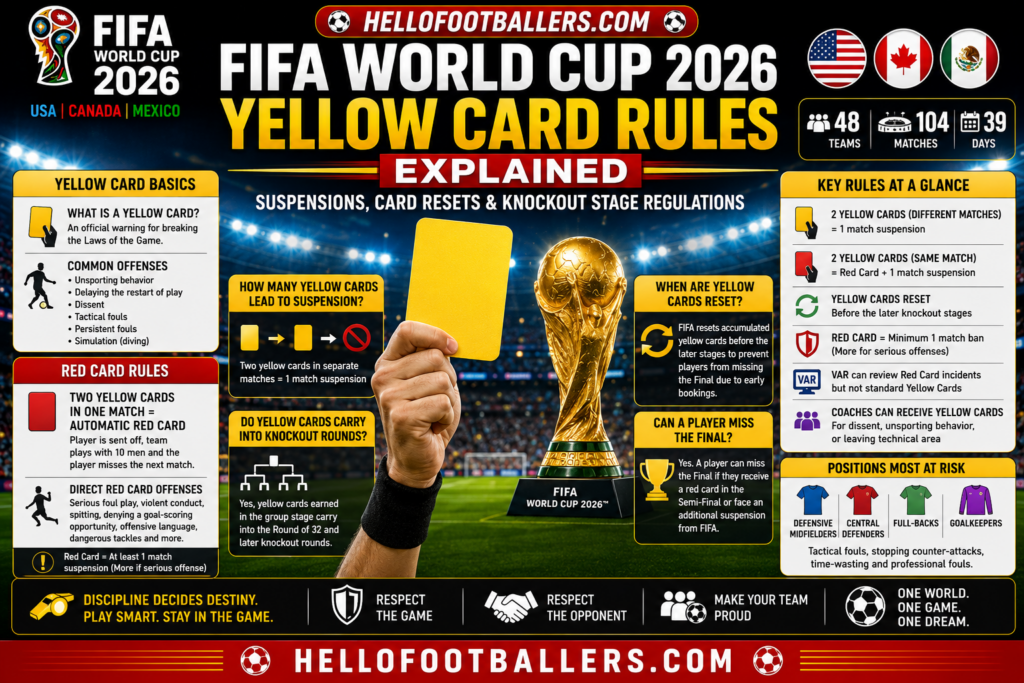

FIFA World Cup 2026 Yellow Card Rules: Yellow cards are one of the most important parts of FIFA World Cup matches. A single booking can affect a player’s availability, while repeated yellow cards can lead to suspensions during crucial games.
With FIFA World Cup 2026 featuring 48 teams and 104 matches, understanding yellow card regulations is more important than ever.
This guide explains everything football fans need to know about yellow cards, suspensions, red cards, and disciplinary rules at FIFA World Cup 2026.
What Is a Yellow Card?
A yellow card is an official warning issued by the referee when a player breaks the Laws of the Game.
The card serves as a caution rather than an immediate dismissal.
Referees show yellow cards for:
- Unsporting behavior
- Delaying the restart of play
- Dissent
- Persistent fouls
- Tactical fouls
- Simulation (diving)
- Entering or leaving the field without permission
How Many Yellow Cards Lead to Suspension?
At FIFA World Cup 2026, a player who accumulates two yellow cards in separate matches will receive a one-match suspension.
Example
Match 1: Yellow Card
Match 3: Yellow Card
Result: One-match suspension
This rule applies throughout the tournament until the yellow card reset stage.
Also read: FIFA World Cup 2026 New Rules Explained
What Happens If a Player Receives Two Yellow Cards in One Match?
If a player receives two yellow cards during the same match:
- First Yellow Card
- Second Yellow Card
- Automatic Red Card
The player is sent off immediately.
The team must continue with 10 players.
The player will also miss the next match.
Do Yellow Cards Carry Into Knockout Rounds?
Yes.
Yellow cards earned during the group stage can carry into the Round of 32 and later knockout rounds.
However, FIFA uses a card reset system to prevent players from missing the Final due to accumulated yellow cards.
When Are Yellow Cards Reset?
FIFA resets accumulated yellow cards before the later stages of the tournament.
This prevents players from reaching the Final with suspension risks based solely on earlier bookings.
The exact reset point is determined by FIFA’s tournament regulations.
Why Does FIFA Reset Cards?
The purpose is:
- Protect competitive balance
- Ensure top players can participate
- Avoid unfair Final suspensions
Can a Player Miss the FIFA World Cup Final?
Yes.
A player can miss the Final if:
- They receive a red card in the Semi-Final.
- They receive a suspension due to disciplinary action.
However, yellow card accumulation rules are designed to reduce the chances of missing the Final.
What Is a Red Card?
A red card means immediate dismissal from the match.
The player must leave the field immediately.
The team continues with one fewer player.
Red Card Offenses
Referees may show a direct red card for:
- Serious foul play
- Violent conduct
- Spitting
- Denying an obvious goal-scoring opportunity
- Offensive language
- Dangerous tackles
Automatic Suspension After Red Card
A player receiving a red card will automatically miss at least the next match.
FIFA may impose additional suspensions depending on the seriousness of the offense.
Examples
- Violent conduct
- Fighting
- Abuse of officials
These incidents can lead to longer bans.
Do Coaches Receive Yellow Cards?
Yes.
Managers and coaching staff can receive yellow cards.
Reasons include:
- Dissent
- Unsporting behavior
- Aggressive conduct
- Leaving technical areas improperly
Repeated offenses may lead to suspensions.
Which Players Are Most At Risk?
Certain positions receive more yellow cards than others.
Defensive Midfielders
Frequently commit tactical fouls.
Central Defenders
Often stop counter-attacks.
Full-Backs
Face fast wingers and commit professional fouls.
Goalkeepers
Can receive cards for time-wasting.
Most Famous World Cup Suspensions
Several legendary players have missed important matches because of disciplinary issues.
Examples include:
- Michael Ballack (2002 Final)
- Claudio Caniggia (1990 Final)
- Various stars suspended in knockout rounds
Disciplinary records can significantly influence tournament outcomes.
VAR and Yellow Cards
VAR cannot review ordinary yellow cards.
However, VAR can review incidents involving:
- Potential red cards
- Mistaken identity
- Serious foul play
The referee may upgrade a yellow card to a red card after a VAR review.
Current Affairs & Latest Updates
At FIFA World Cup 2026, referees continue using:
- VAR technology
- Semi-Automated Offside Technology
- Standard FIFA disciplinary regulations
Players and coaches must carefully manage bookings throughout the tournament.
FAQs
How many yellow cards cause a suspension?
Two accumulated yellow cards in separate matches.
Can yellow cards be reviewed by VAR?
Normally no.
Do yellow cards carry into knockout rounds?
Yes, until the reset stage.
Can a player miss the Final due to yellow cards?
FIFA’s reset system reduces this possibility.
What happens after two yellow cards in one match?
Automatic red card and dismissal.
How long is a red card suspension?
At least one match.
Can coaches receive yellow cards?
Yes.
Do goalkeepers receive yellow cards?
Yes.
What offenses cause yellow cards?
Unsporting behavior, dissent, delaying play, tactical fouls, and more.
Can FIFA increase suspensions?
Yes, for serious misconduct.
Conclusion
Yellow cards play a major role in FIFA World Cup 2026. Players must balance aggression and discipline while avoiding suspensions that could hurt their teams during critical matches. Understanding yellow card accumulation, red card rules, and suspension regulations helps fans better follow one of football’s most important tournaments.
After this article, publish:
- FIFA World Cup 2026 VAR Rules Explained
- FIFA World Cup 2026 Offside Rule Explained
- FIFA World Cup 2026 Extra Time & Penalty Rules
- FIFA World Cup 2026 Handball Rule Explained
- FIFA World Cup 2026 Prize Money Explained
These five articles together can become a strong Google Discover and search traffic cluster.



Ого случайно наткнулся на такое количество без цензуры полных порнофильмов!
Раньше никак не мог найти, а тут все проблемы решены.
Картинка очень четкая, актрисы супер
красивые, невозможно остановиться.
Обязательно сохраняю этот сайт.
Частые обновления. Разные вкусы полных порнофильмов присутствуют.
Теперь только здесь смотрю полные порнофильмы!
成人内容 可通过 有保障 的网站获取。探索 安全的成人网站 以获得高质量内容。
Take a look at my blog post … ebony porn