
Curaçao Makes History on U.S. Soil
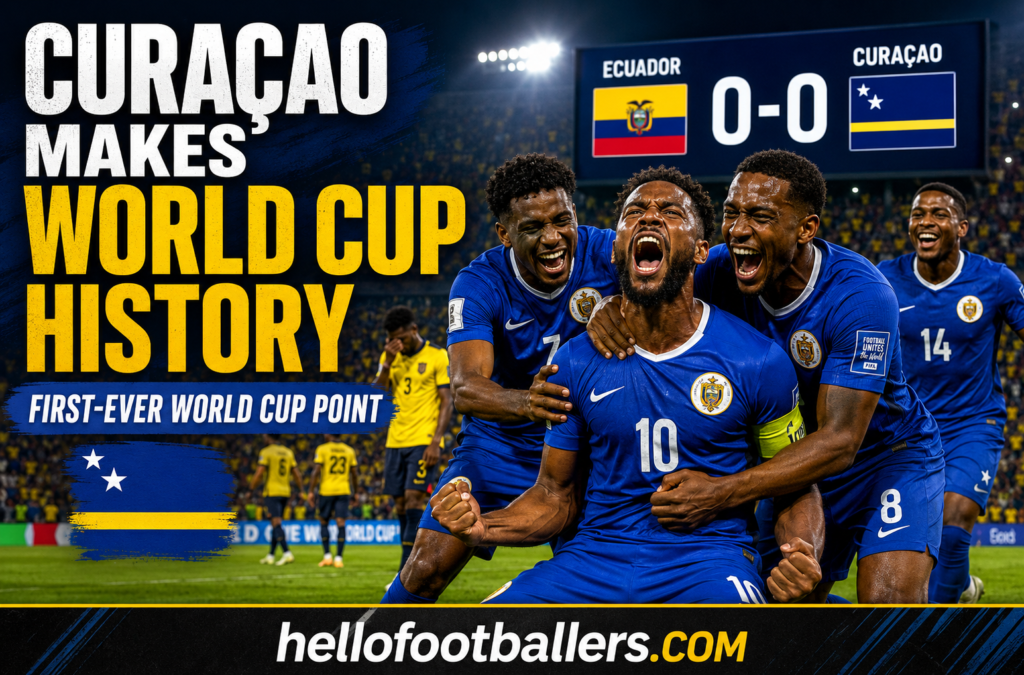
Curaçao created one of the most memorable stories of the FIFA World Cup 2026 by earning the first World Cup point in the nation’s history with a determined 0-0 draw against Ecuador in Group E.
For a small Caribbean nation making its World Cup debut, the result was far more than a scoreless draw. It was a landmark sporting moment. It was proof that discipline, courage, and belief can give an underdog a place in the biggest soccer conversation in the world.
The match was played at GEHA Field at Arrowhead Stadium in Kansas City, Missouri, giving U.S. fans a front-row seat to one of the tournament’s most emotional early moments. Sky Sports listed the match at Arrowhead Stadium with an attendance of 68,598, and FIFA’s match report hub also recorded the Group E result as Ecuador 0, Curaçao 0.
For American soccer fans, this was the kind of World Cup story that makes the expanded 2026 tournament feel bigger and more global. The U.S., Canada, and Mexico are hosting a World Cup with more teams, more markets, and more opportunities for nations outside the traditional elite to write their own chapters. Curaçao’s point against Ecuador was exactly that kind of chapter.
A Historic First Point for Curaçao
Before this match, Curaçao had never earned a point at a FIFA World Cup. The country came into the tournament as a debutant and suffered a painful 7-1 defeat against Germany in its opening Group E match. That result could have damaged confidence and turned the second match into a survival exercise.
Instead, Curaçao responded with one of the grittiest performances of the tournament.
Against Ecuador, a South American opponent with World Cup experience and a strong qualifying background, Curaçao stayed compact, defended with urgency, and refused to collapse under pressure. Ecuador controlled long stretches of the match and created repeated scoring chances, but Curaçao held firm until the final whistle.
The point mattered historically because it changed Curaçao’s World Cup record forever. The nation is no longer just a first-time participant. It is now a country with a World Cup result, a World Cup clean sheet, and a World Cup point.
That distinction matters. For players, coaches, fans, and young athletes back home, this match gave Curaçao a permanent place in World Cup history.
Eloy Room Becomes the Hero of the Night
The biggest individual story of the match was Curaçao goalkeeper Eloy Room.
Room delivered a performance that will be remembered long after the group stage ends. Sky Sports reported that Room made 15 saves, setting a new record for the most saves in 90 minutes of a World Cup match since records began in 1966. ESPN also reported that Room made 15 saves, calling it the most by any goalkeeper in 90 minutes of a World Cup match since records began in 1966.
That number tells the story of the game. Ecuador kept attacking. Curaçao kept resisting. Room kept saving.
From early danger to late pressure, Room stood between Ecuador and the goal that would have changed the match. Every save added to the pressure. Every stop gave Curaçao more belief. By the final minutes, the draw no longer felt like luck. It felt earned.
Room’s display was not only about reflexes. It was about positioning, focus, timing, and leadership. A goalkeeper facing that volume of shots must stay mentally sharp for every second. One hesitation can decide the match. Room never allowed that moment to arrive.
For U.S. readers, there is also an American soccer connection. Sky Sports noted that Room plays for Miami FC in the USL Championship and previously played in Major League Soccer with the Columbus Crew, where he won MLS Cup.
That detail gives the story extra relevance in the United States. A goalkeeper with experience in the American soccer system helped produce one of the defining underdog performances of a World Cup being played in North America.
Ecuador Dominates, But Curaçao Refuses to Break
A 0-0 scoreline can sometimes look uneventful on paper. This match was not uneventful.
Ecuador pushed for a breakthrough repeatedly. Sky Sports reported that Ecuador had 27 shots and produced an expected goals figure of 3.05, yet still failed to score.
That statistic shows how remarkable Curaçao’s defensive effort was. A team facing that much pressure usually concedes at least once. Curaçao did not.
Ecuador’s frustration grew as the match went on. The chances kept coming, but the finish never arrived. Curaçao’s defensive shape absorbed pressure, and Room cleaned up the danger when Ecuador broke through.
The result also created major pressure for Ecuador. Sky Sports reported that Ecuador had only one point from two games and would need to beat Germany to qualify.
For Curaçao, the same result kept hope alive. FIFA’s match center noted that Curaçao, Ecuador, and Côte d’Ivoire could still reach the Round of 32, while Germany had already advanced as Group E winner. (FIFA)
That is what made this draw more than a symbolic achievement. Curaçao did not just earn a first point. The team also entered the final round of group matches still connected to the knockout-stage race.
Why This Result Matters Beyond Group E
Curaçao’s draw matters because World Cup history is often shaped by more than champions and superstars.
Every tournament has teams that carry stories bigger than their odds. Curaçao is one of those teams in 2026.
The country arrived at the World Cup as one of the smallest nations in the tournament field. Le Monde reported before the tournament that Curaçao has a population of about 160,000 and around 4,000 registered footballers.
That context makes the draw against Ecuador even more meaningful. Curaçao is not a country with the player pool, domestic league depth, or global soccer infrastructure of the sport’s major powers. It is a small nation competing on the world’s largest soccer stage.
For a country like Curaçao, one point can inspire a generation. It can make young players believe that international soccer is not only for the giants. It can strengthen national identity. It can bring global visibility to a program that many casual fans may have known little about before this tournament.
This is why underdog results matter. They do not always change who wins the World Cup, but they change who feels included in the World Cup.
A U.S. World Cup Moment With Global Meaning
The 2026 World Cup is being hosted across North America, and matches in U.S. cities are becoming stages for global stories. Curaçao’s draw in Kansas City is a perfect example.
For many U.S. fans, especially those who follow MLS, USL, Concacaf, and Caribbean soccer, this match had multiple layers of interest. Curaçao is part of Concacaf, the same regional confederation as the United States, Mexico, Canada, Jamaica, Haiti, Costa Rica, Panama, and several Caribbean nations. Seeing a smaller Concacaf team earn a World Cup point adds to the region’s story.
It also reflects the growing diversity of soccer audiences in the U.S. World Cup crowds in American stadiums often include fans with roots across the Americas, Europe, Africa, and the Caribbean. A match like Ecuador vs. Curaçao is not only about two national teams. It is about diaspora communities, cultural pride, and the shared experience of watching history happen in a U.S. stadium.
Kansas City, a city with a strong soccer culture, became the place where Curaçao’s World Cup story changed forever. That matters for the American soccer landscape because the 2026 tournament is not only about the U.S. men’s national team. It is also about the United States serving as the stage for stories from around the world.
Curaçao’s first point is now part of that American-hosted World Cup legacy.
From Heavy Defeat to Historic Response
One of the most impressive parts of Curaçao’s achievement is the way the team responded after its opening defeat.
A 7-1 loss to Germany could have left a first-time World Cup team exposed and discouraged. Germany is one of the sport’s traditional powers, and a heavy defeat in the opening match can affect a team mentally as much as tactically.
But Curaçao did not allow that result to define its tournament.
Instead, the team adjusted. The approach against Ecuador was much more controlled. Curaçao showed greater defensive concentration, reduced open spaces, and forced Ecuador to keep searching for a way through.
That response says a lot about the character of the squad. Many teams can play with spirit before adversity arrives. The harder test is what happens after a painful result. Curaçao answered that test with discipline and pride.
The difference between the Germany match and the Ecuador match also shows how quickly a World Cup narrative can change. After the opening defeat, Curaçao could have been viewed simply as a debutant overwhelmed by the stage. After the Ecuador draw, Curaçao became one of the tournament’s best underdog stories.
The Tactical Story: Compact Defense and Goalkeeper Brilliance
Curaçao’s draw was built on a clear defensive plan.
The team did not try to turn the match into a wide-open contest. That would have favored Ecuador, which had the quality and attacking pressure to punish space. Instead, Curaçao focused on staying organized, protecting central areas, and making Ecuador work for every shot.
That kind of performance requires every player to accept defensive responsibility. The back line must stay connected. Midfielders must track runners. Wide players must help protect the flanks. Forwards must relieve pressure when possible. The goalkeeper must command the penalty area and remain ready for repeated saves.
Room’s performance will rightly receive the headlines, but clean sheets of this type are rarely achieved by one player alone. The goalkeeper made the decisive stops, but Curaçao’s entire defensive structure helped keep the match alive.
Still, Room was the difference-maker. When Ecuador found openings, he closed them. When shots came through traffic, he reacted. When pressure built late, he stayed calm.
The result was a perfect example of a goalkeeper changing the story of a match.
Ecuador’s Missed Opportunity
For Ecuador, the draw was a damaging result.
Ecuador entered the match needing a response after losing 1-0 to Côte d’Ivoire in its opening game, a result listed in FIFA’s match report hub for Group E.
A win over Curaçao would have put Ecuador back into a stronger position in the group. Instead, Ecuador left with only one point from two matches.
The frustration for Ecuador is clear. The team created enough chances to win. It had pressure, volume, and territory. But finishing was the problem. When a team takes that many shots and does not score, the conversation inevitably turns to missed chances and composure in front of goal.
Ecuador now faces a difficult final group match against Germany. That is a tough assignment under any circumstances, and even more difficult when qualification pressure is involved.
Curaçao, meanwhile, leaves the Ecuador match with belief restored. The team still has work to do, but it now knows it can survive against a strong opponent at the World Cup level.
What Comes Next for Curaçao?
Curaçao’s final Group E match is against Côte d’Ivoire. FIFA lists Curaçao vs. Côte d’Ivoire for June 25, 2026, at Philadelphia Stadium.
That match now has serious meaning. Curaçao is not simply playing for pride. The team still has a chance to affect the group standings and potentially reach the Round of 32, depending on results.
For Curaçao, the formula is simple in spirit even if the group math may depend on other outcomes: build on the Ecuador performance, defend with the same discipline, and find a way to be more dangerous going forward.
A win over Côte d’Ivoire would be another historic step. Even a strong performance would show that the Ecuador draw was not a one-night miracle but part of a larger competitive breakthrough.
For Côte d’Ivoire, the match will also carry pressure. Group E remains alive beyond Germany’s position at the top, and every point matters.
That sets up a fascinating final group game. Curaçao has already made history, but the team may not be finished yet.
Why Curaçao’s Story Connects With American Fans
American sports fans understand underdog stories. Whether it is March Madness, an unexpected playoff run, or a small-market team beating the odds, U.S. sports culture has always embraced teams that fight above their weight.
Curaçao fits that profile perfectly.
This is a small nation in its first World Cup, coming off a heavy defeat, facing an established South American team, and somehow walking away with a clean sheet and a historic point. That is a story American audiences can connect with immediately.
There is also a human element. Eloy Room’s performance gives fans a clear hero. The team’s defensive effort gives the story drama. The first-ever point gives it historical importance. The match being played in Kansas City gives it a direct U.S. setting.
For websites targeting American readers, this story has strong appeal because it combines World Cup relevance, underdog emotion, Concacaf connection, and a record-setting individual performance.
It is not just a soccer result. It is a sports story.
The Bigger Picture for Concacaf
Curaçao’s result also matters for Concacaf.
The 2026 World Cup gives teams from North America, Central America, and the Caribbean a bigger platform. The three host countries — the United States, Canada, and Mexico — are central to the tournament, but Curaçao’s performance shows that the region’s story extends beyond the hosts.
Caribbean soccer has often been overlooked at the global level. Nations from the Caribbean face challenges related to population size, resources, player development, travel, and domestic league infrastructure. When a Caribbean side earns a result at the World Cup, it carries significance beyond one country.
Curaçao’s point can inspire other smaller nations in the region. It can show that qualification is not the end goal. Competing, earning results, and making history are possible.
The draw also gives Concacaf another talking point during a World Cup hosted partly in the United States. For the region, every strong performance helps build credibility and visibility.
A Night Curaçao Will Never Forget
Some World Cup matches are remembered for goals. Others are remembered for saves, emotion, and what the result represents.
Curaçao’s 0-0 draw with Ecuador belongs in the second category.
The match did not produce a goal, but it produced something bigger for Curaçao: validation. The team proved it could recover from adversity. It proved it could stand up to a strong opponent. It proved it belonged on the stage.
For the players, this point will be remembered for the rest of their careers. For fans in Curaçao, it will be remembered as the night their national team earned its first World Cup point. For neutral fans, it will be remembered as one of those tournament moments that make the World Cup unique.
A scoreless draw can sometimes fade quickly. This one should not.
Conclusion: Curaçao’s First Point Is More Than a Result
Curaçao’s first-ever World Cup point is a milestone for the nation, a major moment for Caribbean soccer, and one of the standout underdog stories of the FIFA World Cup 2026.
The 0-0 draw against Ecuador was built on resilience, defensive organization, and a brilliant goalkeeping performance from Eloy Room. It came after a difficult opening defeat and gave Curaçao new life in Group E.
For U.S. audiences watching the tournament unfold across North America, this was exactly the kind of story that makes the World Cup special. It happened in an American stadium, in front of a large crowd, and it gave a small nation a moment of global recognition.
Curaçao came to the World Cup as a debutant. After the draw against Ecuador, it became something more: a team with history, hope, and a point that will never be forgotten.
Whatever happens next against Côte d’Ivoire, Curaçao has already left its mark on the 2026 World Cup.
The Blue Wave has arrived.