
FIFA World Cup 2026 VAR Rules: Video Assistant Referee (VAR) has completely changed modern football. Since its introduction at the FIFA World Cup, VAR has helped referees make more accurate decisions while reducing major mistakes in important matches.
At FIFA World Cup 2026, VAR continues to play a critical role alongside Semi-Automated Offside Technology and Smart Match Ball Technology.
This guide explains everything fans need to know about VAR rules at FIFA World Cup 2026.
Also read: FIFA World Cup 2026 Yellow Card Rules Explained
What Is VAR?
VAR stands for Video Assistant Referee.
The system uses multiple camera angles and video technology to help referees review important incidents during matches.
The goal is to reduce clear and obvious errors.
Where Is VAR Rules Located?
VAR officials are not on the field.
Instead, they work from a dedicated Video Operation Room.
The team usually consists of:
- Video Assistant Referee
- Assistant VAR Officials
- Replay Operators
They monitor every match in real time.
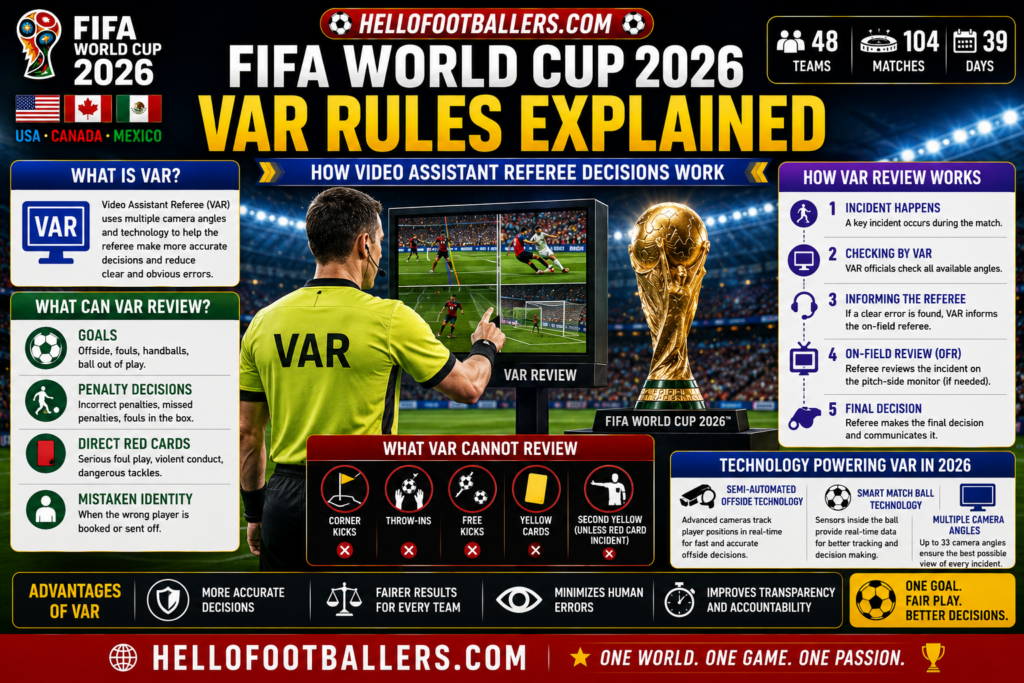
What Incidents Can VAR Review?
VAR can only review four specific situations.
Goals
VAR checks:
- Offside
- Fouls during build-up
- Handballs
- Ball out of play
Penalty Decisions
VAR reviews:
- Incorrect penalties awarded
- Missed penalties
- Fouls inside the box
Direct Red Cards
VAR can recommend reviews for serious offenses.
Examples:
- Violent conduct
- Dangerous tackles
- Serious foul play
Mistaken Identity
If the wrong player receives a card, VAR can correct the decision.
What VAR Cannot Review
VAR cannot review ordinary incidents.
Examples include:
- Corner kicks
- Throw-ins
- Free kicks
- Standard yellow cards
Not every decision can be reviewed.
How VAR Review Works
Step 1
An incident occurs.
Step 2
VAR officials automatically check the incident.
Step 3
If no error is found:
Play continues.
Step 4
If a clear error is detected:
VAR informs the referee.
Step 5
The referee may:
- Accept VAR recommendation.
- Review the incident on the pitch-side monitor.
Step 6
Final decision is announced.
Only the referee can make the final decision.
What Is the VAR Monitor?
The referee may watch replays on a monitor located beside the pitch.
This is called:
On-Field Review (OFR)
The referee watches multiple angles before making a final ruling.
Semi-Automated Offside Technology
World Cup 2026 uses Semi-Automated Offside Technology together with VAR.
How It Works
Special cameras track:
- Player positions
- Ball movement
- Limb locations
The system quickly identifies offside situations and sends alerts to VAR officials.
Smart Match Ball Technology
The official match ball contains sensors.
The ball provides:
- Real-time tracking
- Ball contact data
- Offside assistance
This technology works alongside VAR.
Can VAR Cancel Goals?
Yes.
Goals may be overturned because of:
- Offside
- Handball
- Foul during build-up
- Ball leaving the field
Several World Cup goals have been disallowed after VAR reviews.
Can VAR Award Penalties?
Yes.
VAR can recommend a penalty if:
- Referee missed a foul.
- Handball occurred.
- Incorrect decision was made.
The referee usually reviews the footage before deciding.
Can VAR Give Red Cards?
Yes.
VAR can intervene for:
- Violent conduct
- Dangerous tackles
- Serious foul play
The referee may upgrade a decision from no card to a red card.
Can VAR Remove Yellow Cards?
Normally no.
VAR does not review standard yellow cards.
The exception is when a yellow card is connected to a potential red-card incident.
Why Do Some Reviews Take Longer?
Review times vary because officials must examine:
- Multiple camera angles
- Player positions
- Contact points
- Offside lines
Accuracy is prioritized over speed.
Advantages of VAR
More Accurate Decisions
Reduces major referee mistakes.
Fairer Results
Important incidents receive additional review.
Better Offside Calls
Technology increases accuracy.
Increased Transparency
Fans can see review processes.
Criticism of VAR
Longer Delays
Reviews can interrupt game flow.
Subjective Decisions
Some interpretations remain controversial.
Fan Frustration
Waiting for decisions can reduce celebrations.
Despite criticism, FIFA continues to support VAR.
Famous VAR Moments in World Cup History
VAR has influenced several major World Cup matches.
Examples include:
- Penalty decisions
- Offside goals
- Red card incidents
- Knockout-stage controversies
Many important results have been affected by VAR reviews.
Current Affairs & Latest Updates
For FIFA World Cup 2026:
- VAR remains active.
- Semi-Automated Offside Technology is used.
- Smart Match Ball Technology supports decisions.
- FIFA continues refining the review process.
Technology plays a larger role than ever before.
FAQs
What does VAR stand for?
Video Assistant Referee.
Can VAR review yellow cards?
Normally no.
Can VAR award penalties?
Yes.
Can VAR cancel goals?
Yes.
Who makes the final decision?
The on-field referee.
Can VAR review offside incidents?
Yes.
What is Semi-Automated Offside Technology?
Technology that helps detect offside positions faster and more accurately.
Can VAR give red cards?
Yes.
Does VAR stop the match?
Sometimes during reviews.
Is VAR used in FIFA World Cup 2026?
Yes.
Conclusion
VAR has become one of the most important technologies in football and remains a key part of FIFA World Cup 2026. By assisting referees with goals, penalties, red cards, and offside decisions, VAR helps ensure fairer and more accurate outcomes.
Combined with Semi-Automated Offside Technology and Smart Match Ball Technology, FIFA World Cup 2026 is expected to be the most technologically advanced tournament in football history.
Next Article (Highest Traffic Potential)
FIFA World Cup 2026 Offside Rule Explained: New Technology, VAR Decisions & Common Mistakes
This article usually performs extremely well during every World Cup because millions of fans search for offside explanations after controversial goals.