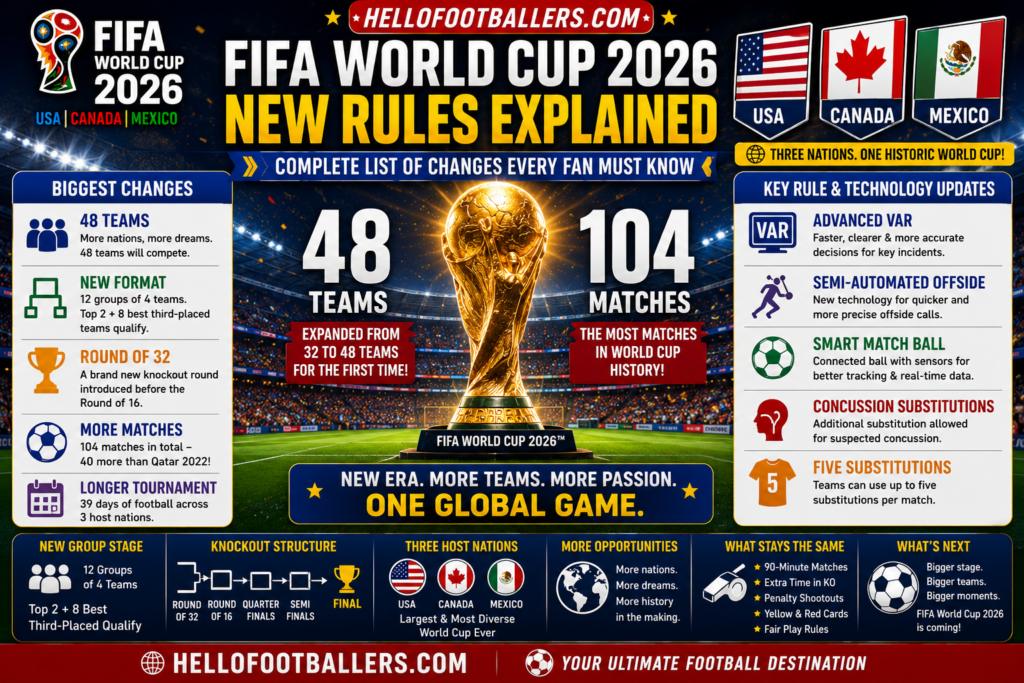

FIFA World Cup 2026 New Rules: FIFA World Cup 2026 is set to be the biggest tournament in football history. Hosted by the United States, Canada, and Mexico, the competition introduces several major changes that will impact teams, players, coaches, and fans worldwide.
From the expansion to 48 teams to updated disciplinary regulations, larger squads, advanced technology, and a new tournament structure, FIFA World Cup 2026 will look very different from previous editions.
This guide explains all the important FIFA World Cup 2026 rules and changes every football fan should know.
Quick Overview of FIFA World Cup 2026 New Rules
| Category | FIFA World Cup 2026 |
|---|---|
| Host Countries | United States, Canada, Mexico |
| Teams | 48 |
| Groups | 12 |
| Teams Per Group | 4 |
| Total Matches | 104 |
| Tournament Duration | 39 Days |
| Round of 32 | Introduced |
| Defending Champion | Argentina |
| Final Venue | MetLife Stadium, New Jersey |
Biggest Change: 48 Teams Instead of 32
The most significant change for FIFA World Cup 2026 is the expansion from 32 teams to 48 teams.
For the first time in history, 48 nations will participate in the tournament.
Previous Format
- 32 Teams
- 8 Groups
- 64 Matches
New Format
- 48 Teams
- 12 Groups
- 104 Matches
This expansion gives more countries an opportunity to qualify for football’s biggest tournament.
New Group Stage Format
The group stage format has changed significantly.
2022 Format
- 8 Groups
- 4 Teams Per Group
- Top 2 Qualified
2026 Format
- 12 Groups
- 4 Teams Per Group
- Top 2 Automatically Qualify
- Best 8 Third-Placed Teams Also Qualify
This means 32 teams will advance to the knockout stage.
Also read: FIFA World Cup 2026 Day 3 Highlights
Introduction of Round of 32
For the first time ever, FIFA World Cup will feature a Round of 32.
Knockout Structure
Round of 32
↓
Round of 16
↓
Quarter-Finals
↓
Semi-Finals
↓
Third Place Match
↓
Final
This change increases the number of knockout matches and creates more opportunities for surprises.
More Matches Than Ever Before
The 2026 World Cup will feature:
Total Matches
104
Compared to:
- 2022 World Cup: 64 Matches
- 2018 World Cup: 64 Matches
- 2014 World Cup: 64 Matches
Fans will enjoy 40 additional matches.
Three Host Nations
For the first time in history, three countries will host a FIFA World Cup together.
Hosts
- United States
- Canada
- Mexico
This makes FIFA World Cup 2026 the largest geographically distributed tournament ever.
Expanded Squad Size
Teams are expected to continue using larger squad sizes introduced in recent major tournaments.
Benefits
- Better player management
- Reduced injury risks
- More tactical flexibility
- Opportunities for young players
Managers now have greater depth available throughout the tournament.
Advanced VAR Technology
Video Assistant Referee (VAR) continues to play a major role.
VAR Checks
- Goals
- Penalties
- Red Cards
- Mistaken Identity
The technology has become faster and more accurate than previous editions.
Semi-Automated Offside Technology
One of the biggest technological innovations remains Semi-Automated Offside Technology.
How It Works
Special cameras track player movements and ball position in real time.
Benefits include:
- Faster decisions
- More accurate offside calls
- Reduced referee errors
Smart Match Ball Technology
FIFA continues using smart ball technology.
Features
- Sensors inside the ball
- Real-time tracking
- Improved offside detection
- Enhanced match analysis
This technology helps officials make quicker and more accurate decisions.
Concussion Substitution Rule
Player safety remains a priority.
Concussion Substitutions
Teams may receive additional substitutions if a player suffers a suspected concussion.
The rule aims to protect player health and encourage proper medical evaluations.
Five Substitutions Rule
Teams can continue using five substitutions during matches.
Benefits
- Reduced player fatigue
- Better injury prevention
- Greater tactical options
This rule became popular after its introduction and remains in place.
New Opportunities for Smaller Nations
The 48-team expansion benefits many football nations.
Regions Benefiting Most
- Africa
- Asia
- CONCACAF
- Oceania
Several countries are making their World Cup debut because of the expanded format.
More Rest Days for Players
FIFA has adjusted scheduling to help players recover during the longer tournament.
Benefits
- Improved player performance
- Reduced injuries
- Better match quality
Increased Prize Money
FIFA is expected to distribute record-breaking prize money during the 2026 tournament.
With more teams and more matches, financial rewards are likely to be higher than previous editions.
New Stadium Experiences
World Cup 2026 stadiums will feature:
- Improved fan experiences
- Enhanced security systems
- Advanced broadcasting technology
- Better accessibility
Fans attending matches will enjoy the most technologically advanced World Cup ever.
How Teams Qualify for Knockout Stage
Automatic Qualification
Top 2 teams from each group.
Additional Qualification
Best 8 third-placed teams across all groups.
This ensures more teams remain competitive until the final group-stage matches.
What Has Not Changed?
Several traditional World Cup rules remain unchanged.
Still the Same
- 90-minute matches
- 15-minute halftime
- Extra time in knockout rounds
- Penalty shootouts
- Yellow and red cards
- VAR review system
Why FIFA Introduced These Changes
FIFA believes expansion will:
- Increase global participation
- Develop football worldwide
- Generate more revenue
- Create additional opportunities for emerging nations
- Expand the sport’s popularity
The organization sees the 2026 World Cup as a major step in football’s global growth.
Current Affairs & Latest Updates
- FIFA World Cup 2026 is the first tournament with 48 teams.
- The competition includes 104 matches.
- United States, Canada, and Mexico are hosting jointly.
- The Round of 32 has been added.
- Semi-Automated Offside Technology continues to be used.
- The tournament is expected to become the most-watched World Cup ever.
Frequently Asked Questions
How many teams are playing in FIFA World Cup 2026?
48 teams.
How many groups are there?
12 groups.
How many teams qualify for the knockout stage?
32 teams.
What is the new knockout round?
Round of 32.
How many matches will be played?
104 matches.
Which countries are hosting?
United States, Canada, and Mexico.
Will VAR be used?
Yes.
What is Semi-Automated Offside Technology?
Technology that helps referees make faster and more accurate offside decisions.
Will five substitutions be allowed?
Yes.
Why was the tournament expanded?
To increase participation and global football development.
Conclusion
FIFA World Cup 2026 represents the biggest transformation in World Cup history. With 48 teams, 104 matches, a new Round of 32, advanced technology, and three host nations, fans can expect the largest and most exciting football tournament ever held.
The new format creates more opportunities for underdog nations, more matches for supporters, and a truly global celebration of football. As the tournament approaches, understanding these new rules and changes will help fans enjoy every moment of FIFA World Cup 2026.